Rules & rights · EU
The EU tyre label, on paper: what Regulation (EU) 2020/740 requires and how to read it
What the EU energy label on tyres shows - fuel efficiency, wet grip, noise and the snow and ice pictograms - how the classes are tested, and what the Commission's own pages say about EPREL, the public registry covering tyres that must be sold bearing a label in the EU.
On video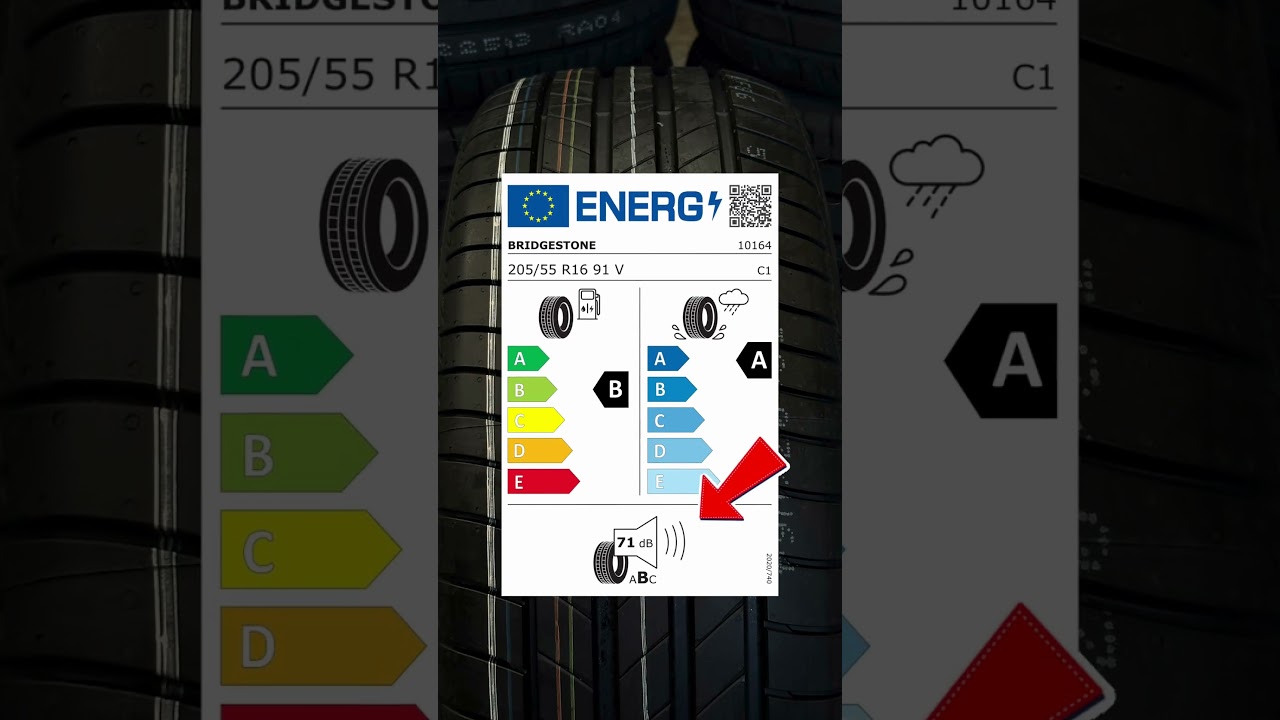 What Does the EU Tyre Label Actually Mean?TyrePartner · opens the player
The recording belongs to TyrePartner and plays from YouTube; opening it lets YouTube see the request. Watch on YouTube.
Every tyre sold in the European Union arrives with two sets of rules behind it. One governs what the tyre must be able to do; the other governs what the buyer must be told. The European Commission's overview of tyre policy names them both: minimum requirements for placing tyres on the Union market sit in Regulation (EU) 2019/2144 on type-approval for motor vehicles, while the information the buyer sees is set by Regulation (EU) 2020/740, the Tyre Labelling Regulation, adopted on 25 May 2020. Both sets of rules use international UNECE test methods to assess tyre performance.
The label exists because tyre properties pull against each other. The Commission's pages describe tyres as sophisticated products in which safety, efficiency and environmental performance conflict and must be balanced, and the label as a means of giving consumers a clear and common classification of that performance. The stakes are not trivial: according to Commission figures dated from the Ecodesign Impact Accounting Overview Report 2024, 1.6 billion vehicle tyres were in use in the EU27 in 2020, of which 88% were car tyres, and the vehicles carrying them travelled some 4106 billion kilometres. The same source puts fuel losses due to tyre rolling resistance at 1.16 litres per 100 km in 2020, reduced by 7.2% thanks to the labelling regulation compared with the level otherwise expected; the projection is 9.4% by 2030.
What the label displays
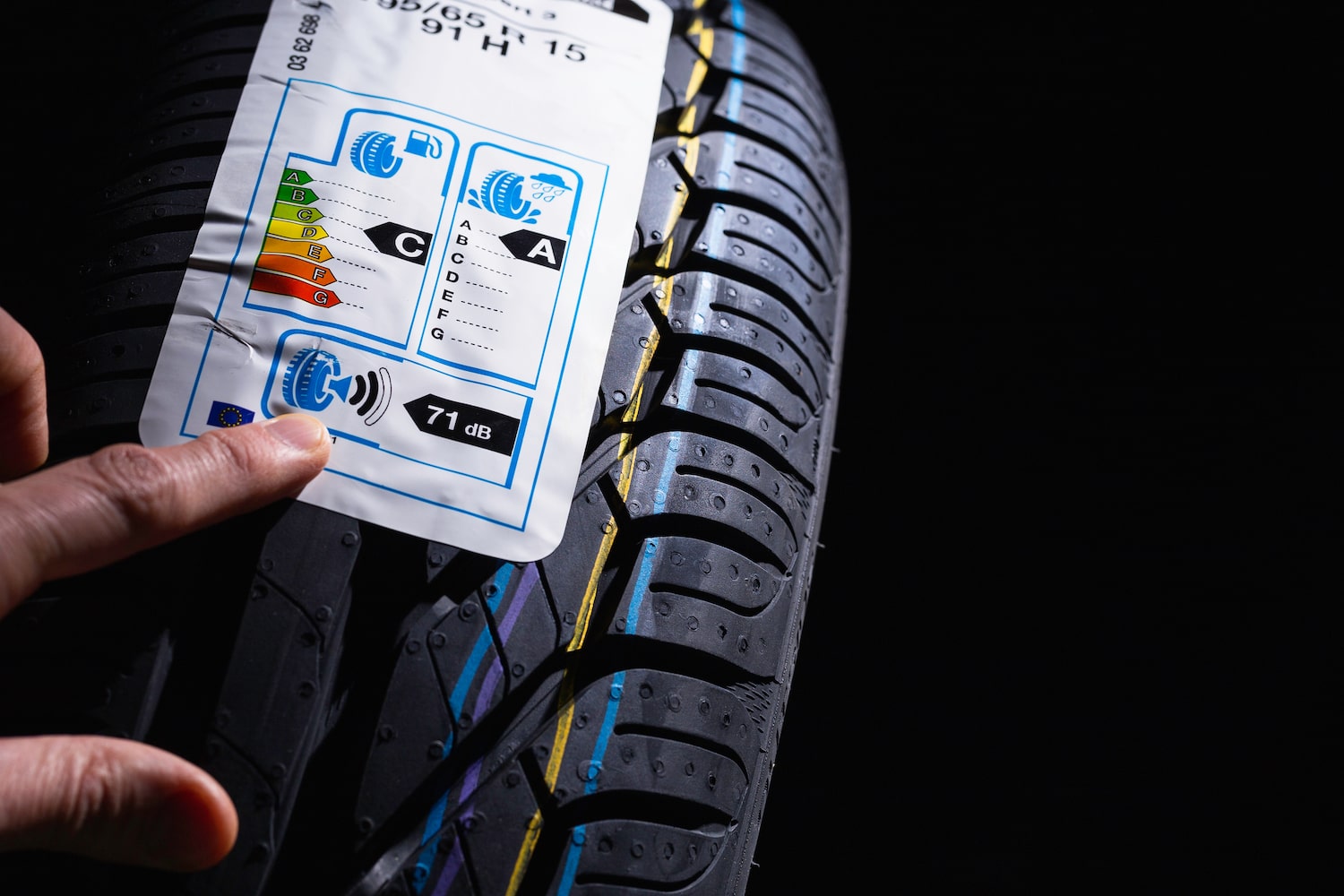
The label carries five parameters, assessed through standardised tests. The Commission lists them as follows.
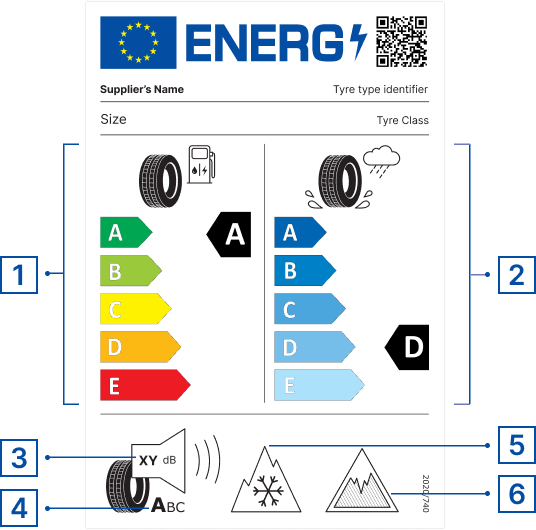
- Rolling resistance class, rated A to E
- Wet grip class, also rated A to E
- External rolling noise level, in decibels
- External rolling noise class, rated A to C
- Whether the tyre qualifies as suitable for snow or ice conditions, by pictogram
Three of these are the core performance parameters. The Commission notes that different performance aspects compete, so manufacturers aim for a best compromise across everything the label shows and more. The list of tyres that fall outside the labelling scope is set in Article 2 of the Tyre Labelling Regulation; the Commission's overview mentions examples such as T-type temporary-use spare tyres and tyres for vehicles first registered before 1 October 1990, and refers readers to Article 2 for the complete list.
Why there is no class below C on wet grip for many tyres - and other class notes
The span of classes on the label has narrowed as type-approval rules tightened. The Commission states that from seven classes for rolling resistance and wet grip, only five now appear on the current label, and that further restrictions from 2024 reduce the number of populated classes to four. For noise, it says only two of the three classes shown are actually populated. The label's A to E scale is thus a printed scale; which classes are genuinely available has been shrinking as the worst performers are progressively outlawed on the type-approval side.
Rolling resistance: hysteresis and why it matters
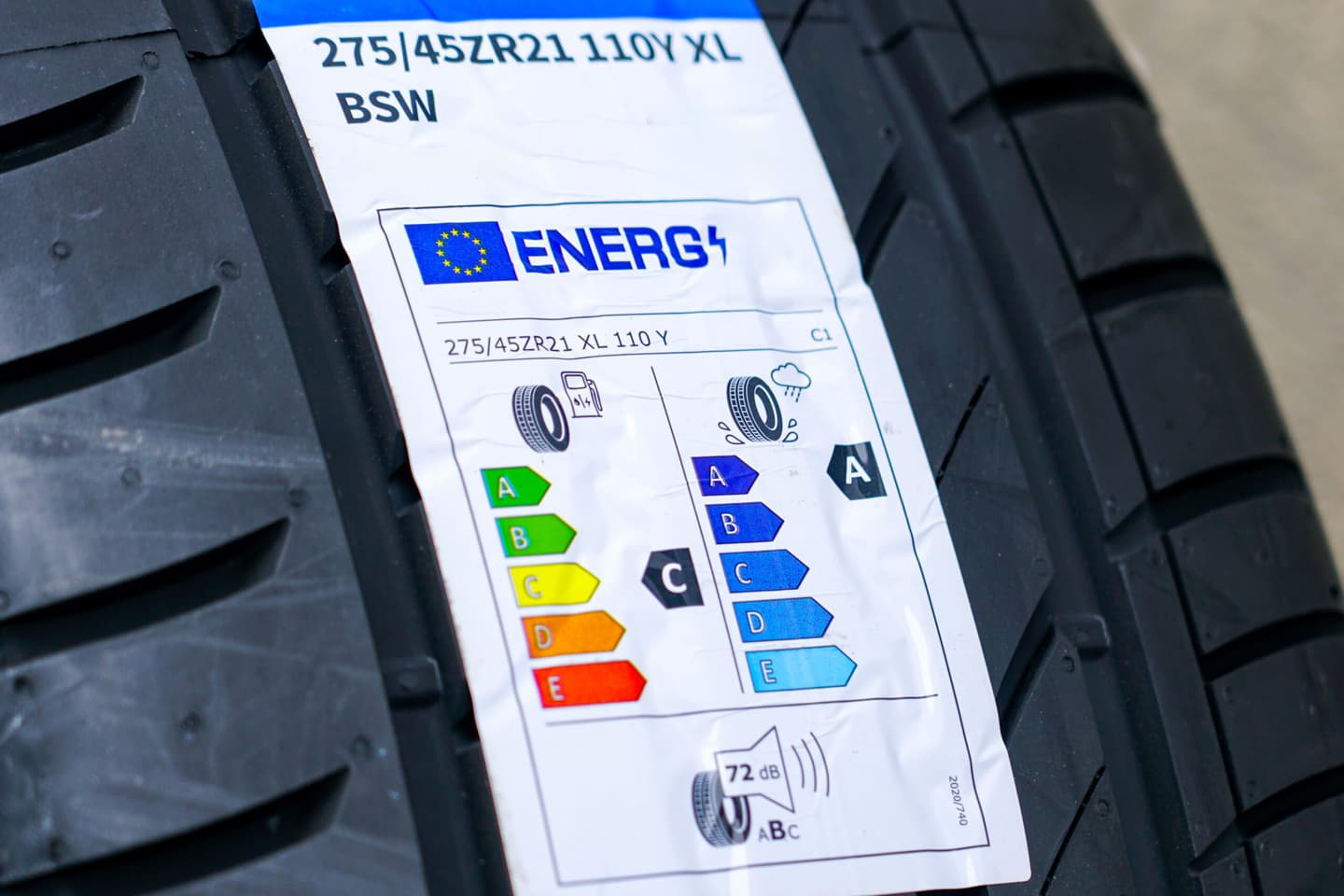
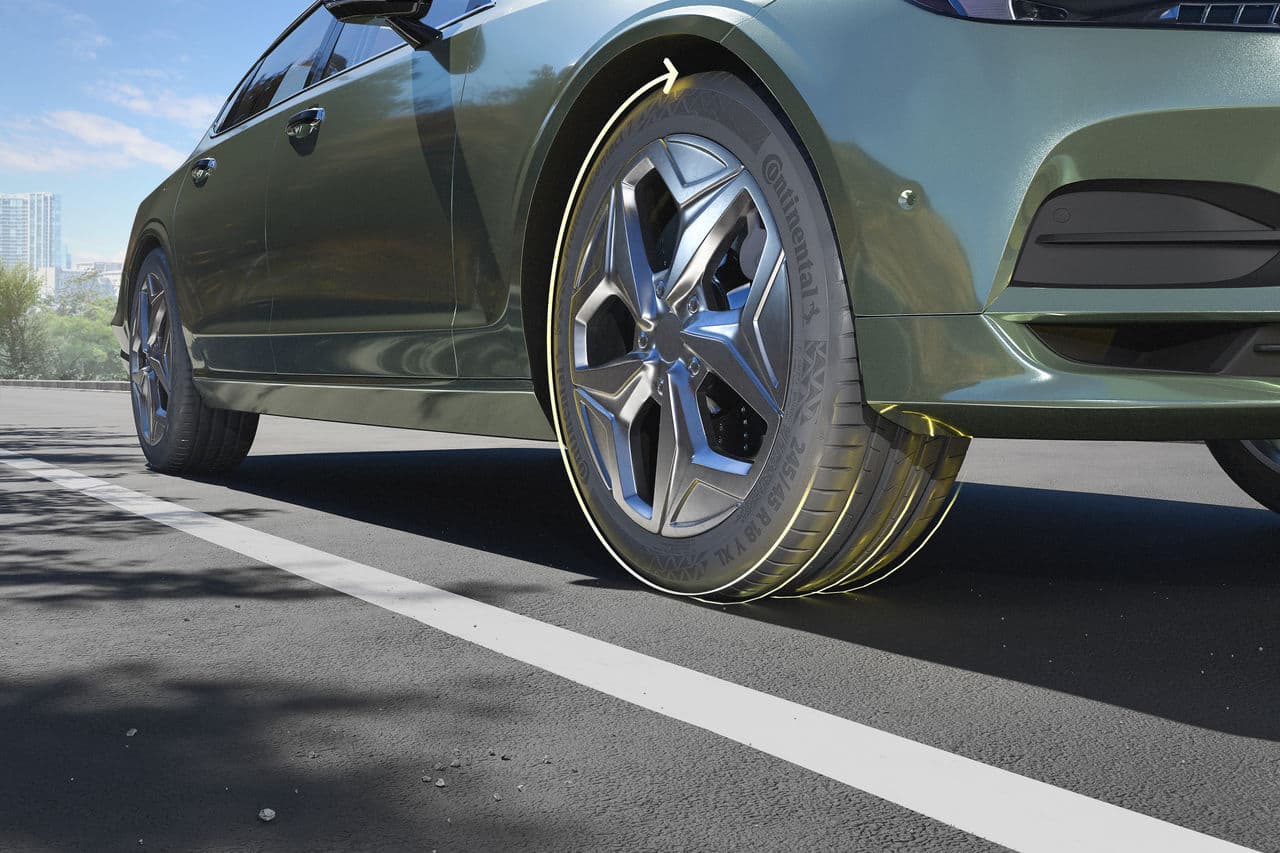
Rolling resistance is the energy a tyre absorbs as it turns, converting into heat. The Commission's properties page explains that as a tyre flexes, friction between molecules produces heat - a hysteresis loss - and that this accounts for over 90% of the total rolling resistance, the remainder coming from adhesion and sliding between road and tyre. It accounts for roughly 40% of a diesel truck's energy consumption, according to the same source. Class boundaries are defined numerically against the Rolling Resistance Coefficient, with limits per class set out in Annex I of the Tyre Labelling Regulation and given separately for C1 passenger-car, C2 van and C3 bus/truck tyres. For C1 tyres, the range runs from 6.5 N/kN or less for class A to 10.6 N/kN or more for class E.
Wet grip: metres, not numbers
Wet grip is the tyre's ability to stick to the road in wet conditions - crucial for safety, as the Commission's page points out, and a factor in the aquaplaning risk when tread design cannot clear water. Class differences are measured in stopping distance: each class step corresponds to a few extra metres needed to stop the vehicle on a wet surface. Limits are set as a wet grip index in Annex I of the Tyre Labelling Regulation. Wet grip degrades with age and, in particular, with wear as tread depth falls, which is why the legislation sets a minimum requirement for wet grip in half-worn tyres.
Noise: how it is measured
The external rolling noise shown on the label is measured in A-weighted decibels, dB(A), marked on the label with a pictogram of a loudspeaker. The Commission's properties page describes the test: a microphone at the height of the ears of an average tall person records the vehicle as it passes by eight times at around 80 km/h for car and van tyres, or around 70 km/h for bus and truck tyres. The class does not follow directly from the measured level, but from limits set under UN ECE Regulation 117, which differ between tyre classes and are more generous - a 1 dB(A) allowance - for winter and XL tyres. Noise limits have been more stringent since January 2023.
What is coming next
Two additions to the label are planned, both pending suitable test methods. Mileage - kilometrage, in the Commission's terminology - is an indicator of durability measured in total distance run until tread depth reaches the safety minimum of 1.6 mm for passenger cars. A 2019 consumer survey cited by the Commission found mileage and rolling resistance the most relevant parameters in replacement-tyre choice after wet grip. Abrasion and mileage indicators will be added to the label once appropriate testing methods exist, as foreseen by the labelling regulation; the Commission's overview also refers to upcoming minimum requirements on microplastic emissions from tyre abrasion and to labelling of retreaded bus and truck tyres.
How to check a tyre yourself
Every tyre label carries a QR code linking to EPREL, the European Product Registry for Energy Labelling. For any tyre that must be sold with a label in the EU, EPREL holds more detailed information than the sticker itself, including all the rated parameters. The registry is public, so you can check a tyre's claimed classes there before buying, and compare several tyres side by side without relying on a dealer's summary. Note that the vehicle dealer also has obligations: the Commission states that a purchase offer must include the label information for any tyre that could be mounted as first equipment.
Nothing on this page constitutes a verdict on any brand. The figures here are those the European Commission publishes, with the dates its own pages carry, and rules and limits change as the regulation is updated; check EPREL and current Commission guidance before making a purchase decision.