How it works · DE
Germany's i-Kfz and the digital vehicle registration document: what the KBA's own pages say
Internet-based vehicle registration in Germany rests on the Central Vehicle Register receiving general inspection data, according to the Kraftfahrt-Bundesamt's English pages. The digital registration certificate (DFZ) works in the i-Kfz app but has documented limits: it is valid only in Germany, cannot be printed, and the paper certificate is still required abroad and at the general inspection.
On video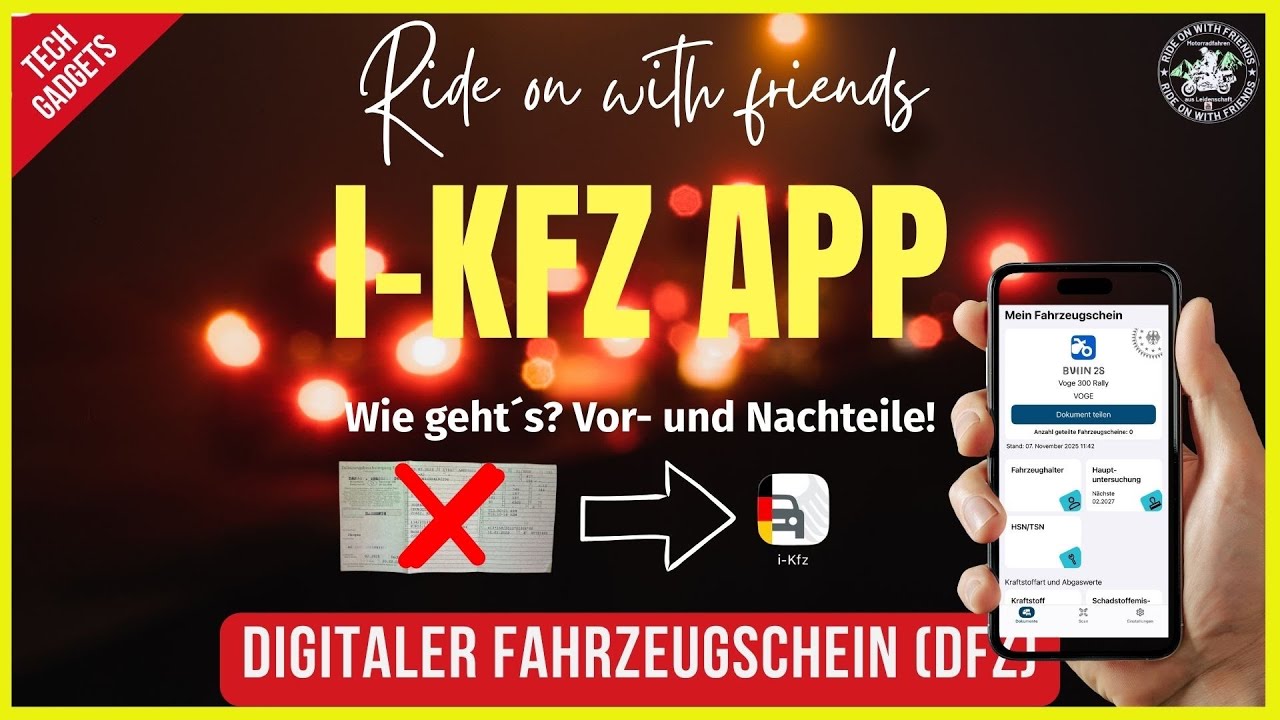 Digitaler Fahrzeugschein ! So funktioniert die i-Kfz App | Schritt-für-Schritt erklärtRide on with friends - Join the journey · opens the player
The recording belongs to Ride on with friends - Join the journey and plays from YouTube; opening it lets YouTube see the request. Watch on YouTube.
Germany's vehicle registration system has been moving online for a decade, and two English-language pages published by the Kraftfahrt-Bundesamt (KBA), the German federal motor transport authority, set out how it works and where it stops. This is a standing reference item on the German market; the facts below are taken from the KBA's pages on the Central Vehicle Register (ZFZR) and on the digital vehicle registration document (DFZ) as they were read at the time of preparation.
The i-Kfz project, which the authority describes as an initiative of the Federal Ministry for Digital and Transport (BMDV), modernises vehicle registration in stages. Internet-based decommissioning of vehicles has been possible since 01.01.2015, and the second stage, introduced on 01.10.2017, allowed owners to apply for re-registration of a vehicle to the same owner within the same registration district using a reserved number plate.
Why inspection data had to enter the register
Internet-based re-registration has a technical precondition: the authority must be able to check electronically that a valid general inspection (HU - Germany's roadworthiness test) exists for the vehicle. The KBA states that the date of the main inspection has been continuously updated in the Central Vehicle Register since the second stage went into operation on 1 October 2017, and that the inspection bodies are electronically connected to transmit the data, if possible immediately after the inspection. The same applies to the safety inspection (SP).
The wider data feed also comes from European Union law. The KBA ties it to the EU's "Roadworthiness Package" and says that, in simultaneous implementation of Directives 2014/45/EU and 2014/46/EU, results of all main inspections and safety inspections are transmitted to the KBA and stored in the Central Vehicle Register.
The roll-out of stored data itself came in two steps: from 01.10.2017, the month and year of the expiry of the deadline for the next main inspection or safety inspection must be transmitted and stored; the voluntary reporting of further data becomes mandatory from 20.05.2018, including the odometer status (the read odometer reading at the time of inspection).
What the digital registration document is and how it is obtained
The digital vehicle registration document (DFZ) is, per the KBA FAQ page, the digital version of the registration certificate part I - the vehicle registration certificate - provided directly in the i-Kfz app. Vehicle owners can add it using the eID (online ID) function of their German ID card, or by scanning a QR code issued by their local vehicle registration authority on site or as part of an online registration process. The document can also be received from another person who has already downloaded it, by sharing from app to app or online.
The app keeps the data current on its own. According to the FAQ, the app checks at every start whether the registration document data is up to date, and new data from the periodic technical inspection or safety inspection is transferred to the app automatically. When a new paper document is issued, the corresponding digital document becomes invalid in the app.
Sharing, deletion and documented limits
The FAQ records several operational limits that matter in practice:
- The app is only valid in Germany; the FAQ answers the question of validity abroad with "No".
- It is not possible to print the digital vehicle registration document, and it would not be valid in printed form; only the digital form is valid.
- The paper-based vehicle registration document must still be carried when travelling in/abroad.
- The paper-based vehicle registration certificate must be presented during the general inspection (TÜV).
- When sharing the document, no selective redaction is possible; it is not possible to choose which information is passed on.
Deletion and deregistration are separate actions. According to the FAQ, deleting the digital document in the app removes only the data in the app; the vehicle remains registered. If a vehicle is taken out of service, the digital document automatically becomes invalid. Only the person who originally downloaded the document may pass it on, and deleting a document also deletes any versions that were passed on from it.
Offline use and checks
Offline behaviour is limited by design. The FAQ states that not all functions of the app are available offline: a digital registration document that has already been added can be displayed and its data viewed, but a new document cannot be added, shared or deleted without a connection. During an inspection of the document, the holder presents the mobile device without handing it over - for example to the police - and the validity of the digital document is determined by visual inspection.
Scope of coverage is broad by class: the FAQ says the digital registration document can be issued for all vehicle classes, and that it also works with special licence plates such as export and seasonal plates and plates for public authority vehicles. Not covered, per the same page: vehicles that run on insurance plates, such as e-scooters or motor scooters with a maximum speed of up to 45 km/h, which do not go through the traditional registration process and do not receive a registration document part I.
How to verify this yourself
The primary sources are on the Kraftfahrt-Bundesamt's English website: the Central Vehicle Register page on extending the ZFZR with general inspection data, and the Digital vehicle registration document FAQ under the i-Kfz app section. Check the current wording there before relying on any detail - app behaviour, validity rules and documentation can change. For anything specific to your vehicle, the FAQ points incorrect data questions to your local vehicle registration authority.